
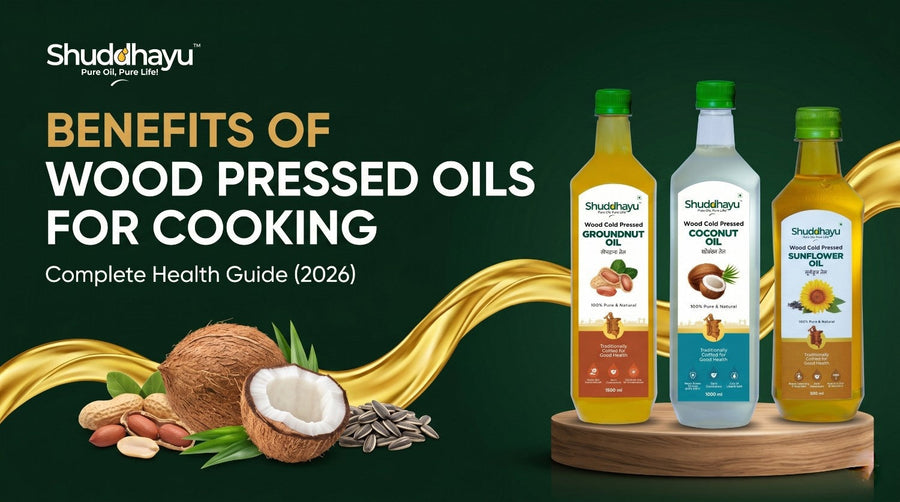
Most people believe all cooking oils are the same — but the oil you cook with daily could significantly impact your health. Refined oils go through heavy chemical processing that strips away nutrients.
By the end of this guide, you'll understand the real benefits of wood pressed oils for cooking, how they compare to refined oils, and how to choose the right oil for your kitchen.
Browse our full range of wood pressed cooking oils →
Key Takeaways
- Wood pressed oils are extracted using traditional wooden ghani machines at low temperatures, helping preserve natural nutrients.
- Unlike refined oils, wood pressed oils do not undergo chemical processing, bleaching, or deodorization.
- Refined oils may lose up to 80% of natural antioxidants during high heat processing.
- Wood pressed oils retain natural flavour and micronutrients.
- Always check that oils are extracted using wooden ghani and not steel expellers.
- Genuine wood pressed oils usually cost ₹400–₹900 per litre.
What Are Wood Pressed Oils?
Wood pressed oil is a traditional cooking oil extracted using wooden ghani machines that operate at low temperatures to preserve nutrients.
The process uses a wooden mortar system that slowly crushes oil seeds such as groundnut, sesame, coconut, and safflower.
Because the extraction happens slowly without excessive heat:
- Natural antioxidants remain intact
- Fatty acid structures stay stable
- Oils retain natural aroma and flavour
Refined Oil vs Cold Pressed vs Wood Pressed Oil
| Feature | Refined Oil | Cold Pressed Oil | Wood Pressed Oil |
|---|---|---|---|
| Extraction | Chemical + high heat | Mechanical press | Wooden ghani slow press |
| Temperature | 200°C+ | Moderate | Low temperature |
| Nutrient retention | Low | Medium | High |
| Processing | Heavy refining | Minimal | Traditional |
| Flavor | Neutral | Natural | Rich aroma |
You can explore chemical free cooking oils here:
Shop wood pressed oils collection →
Why Choosing the Right Cooking Oil Matters
The cooking oil you use daily directly impacts long-term health because oils are used almost every day in Indian cooking.
According to the World Health Organization, unhealthy dietary fats contribute significantly to cardiovascular disease worldwide.
Refined oils often go through multiple industrial steps including:
- Degumming
- Neutralization
- Bleaching
- Deodorization
These steps remove impurities but also remove natural nutrients.
Traditional oils like groundnut, sesame, and coconut oils retain more natural compounds due to slow extraction.
Benefits of Wood Pressed Oils for Cooking
1. Better Nutrient Retention
Wood pressed oils retain nutrients because they are extracted at lower temperatures.
High heat processing destroys compounds like Vitamin E, polyphenols, and natural antioxidants.
Refining processes can reduce antioxidant levels significantly according to food processing studies.
2. Chemical-Free Extraction
Many refined oils use solvent extraction methods.
Wood pressed oils rely only on mechanical crushing using traditional ghani machines.
For example:
Wood Cold Pressed Groundnut Oil →
3. Natural Antioxidants
Wood pressed oils contain natural antioxidants such as tocopherols and plant sterols.
These compounds may help support metabolic and cardiovascular health when consumed as part of a balanced diet.
4. Better Flavor
Wood pressed oils retain the natural aroma of seeds.
This enhances dishes like:
- Tadka
- Curries
- Stir fry
- Chutneys
Example:
Wood Cold Pressed Sesame Oil →
5. Suitable for Daily Cooking
Different wood pressed oils work well for different cooking styles.
| Oil | Best For |
|---|---|
| Groundnut Oil | Frying & sautéing |
| Sesame Oil | Traditional dishes |
| Coconut Oil | South Indian cooking |
| Safflower Oil | Light cooking |
Wood Cold Pressed Safflower Oil →
What to Look for When Buying Wood Pressed Oils
- Wooden ghani extraction
- No chemical processing
- Minimal filtration
- Glass bottle packaging
- Transparency about seed sourcing
Common Mistakes Buyers Make
Mistake #1: Assuming refined oil is healthier
Many buyers think refined oils are healthier because they appear clear and neutral.
However, this clarity often results from heavy processing that removes natural nutrients.
Mistake #2: Ignoring extraction method
Some oils labeled "cold pressed" are actually produced using steel expellers.
Look specifically for oils extracted using wooden ghani methods.
Mistake #3: Choosing oil only based on price
Wood pressed oils are typically more expensive because production is slower and yields are lower.
Our Recommended Wood Pressed Oils
Wood Cold Pressed Groundnut Oil
Groundnut oil is versatile and widely used in Indian cooking.
Wood Cold Pressed Sunflower Oil
Sunflower oil provides a lighter taste and contains natural Vitamin E.
Wood Cold Pressed Coconut Oil
Coconut oil contains medium chain triglycerides (MCTs) and is widely used in South Indian cuisine.
Browse the complete collection of traditional wood pressed oils.
Explore Wood Pressed Oils →
Frequently Asked Questions
Are wood pressed oils healthier than refined oils?
Wood pressed oils retain more natural antioxidants and nutrients because they are extracted at low temperatures without chemical refining.
Is wood pressed oil good for daily cooking?
Yes. Oils like groundnut, sesame, sunflower, and coconut oil are suitable for everyday cooking including sautéing and curries.
Why are wood pressed oils expensive?
Production is slower and yields are lower compared to industrial extraction methods.
Which wood pressed oil is best for cooking?
Groundnut oil works well for frying, sesame oil for traditional cooking, and coconut oil for South Indian dishes.
Final Thoughts
Choosing the right cooking oil comes down to extraction method, processing level, and nutrient retention.
Wood pressed oils follow traditional extraction techniques that help preserve natural nutrients and flavor.
If your goal is healthier cooking and chemical-free ingredients, switching to wood pressed oils is a meaningful improvement.
Written by: Shuddhayu Editorial Team
Last updated: April 2026
Disclosure: Shuddhayu Oils publishes this article and sells some of the products mentioned.


